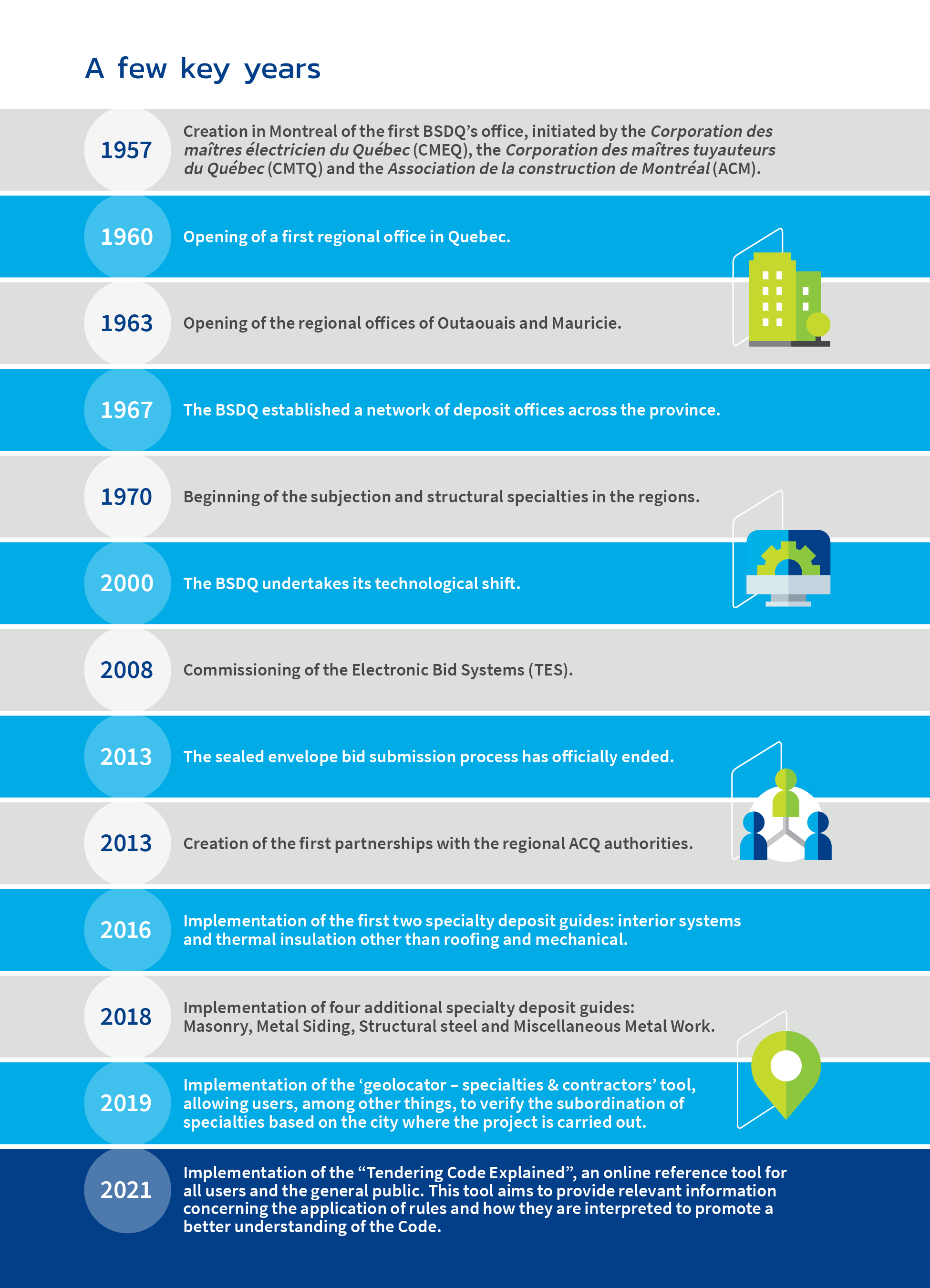
In 1957, thanks to the initiative of a group of electrical and plumbing contractors, the first bid office was established. Concerned with fostering more harmonious relationships among bidders, these contractors aimed to create healthier competition in the industrial and commercial construction sectors.
An agreement was reached between the Corporation des maîtres électriciens du Québec, the Corporation des maître tuyauteurs du Québec, and the Association de la construction de Montréal, thus creating the Bureau des soumissions déposées de Montréal. The experience was later extended to other regions. In 1960, the BSDQ was established in Quebec City, then in Mauricie and Outaouais in 1963.
It was only in 1967 that the BUREAU DES SOUMISSIONS DÉPOSÉES DU QUÉBEC came into its current form. An initial agreement was signed between the Corporation des maîtres électriciens du Québec, the Corporation des maîtres mécaniciens du Québec, and the Fédération de la construction du Québec (now the Association de la construction du Québec), establishing bid offices in major cities across the province. This initial provincial agreement was supplemented three years later by a new agreement subjecting exclusive mechanical and electrical work, as well as some non-exclusive work, to provincial oversight. This agreement provided mechanisms that allowed other specialized work to be voluntarily and regionally subjected. It also integrated the Bureau des soumissions déposées de Montréal, which had remained autonomous until then.
Today, three provincial organizations lead the BSDQ:
- L'Association de la construction du Québec;
- La Corporation des maîtres électriciens du Québec;
- La Corporation des maîtres mécaniciens en tuyauterie du Québec.
The BSDQ
The BSDQ is now active throughout Quebec and receives around 40,000 tenders per year for approximately 4,500 registered projects.
For more than 40 years, the BSDQ has fulfilled its mission through an envelope deposit system administered by staff located in all major cities of Quebec.
In 2008, the BSDQ implemented an advanced tool capable of receiving and transmitting tenders via Internet access: the electronic tender transfer system (TES). However, it maintained the coexistence of the envelope tender system and the electronic tender system until January 2013 to ensure a smooth transition to electronic solutions at everyone's own pace. Since February 2013, the TES is the only tool used for the reception and transmission of tenders.
The Bureau des soumissions déposées du Québec was essentially created to regularize and improve the tender procedures. The main objective pursued by the BSDQ is to foster fair competition, particularly in the commercial and industrial construction sectors.
The BSDQ regulates all activities surrounding a tender and enforce fair and uniform rules for all. It ensures to protect users against certain unfair practices.
The BSDQ's public interest character has been recognized by the courts as a collective contract promoting honesty and maintaining healthy competition in the construction field. Using the BSDQ provides effective framework to the bidding process and ensures the protection of public interest. Practically, this protection extends to bidders, project owners, architects, engineers, and general contractors. As a result, everyone benefits, and ultimately, the general public reaps the rewards.
The very essence of the BSDQ revolves around these three main elements: first, assisting bidders; second, collaborating with project owners; and third, defending the public interest.