
File 2 - Awarding of contracts
Step 1
First contact with the BSDQ
Step 2
How to use the BSDQ
Step 3
After the project owner's closure
Step 4
Complaint

At the BSDQ, the contract in a specialty can be awarded up to the lowest that is both compliant and bonded among those taken possession of by the recipient contractor.
However, if no bid guarantees are provided, the contract can be awarded to any bidder.
Thus, attaching a guarantee to a bid can grant a right to the contract.
As a result, here are the possible situations:
- When all bids reach or exceed $100,000 before taxes, they must be accompanied by a bid guarantee (refer to Step 2 – Sheet 3). Consequently, the contract is awarded to the lowest compliant and bonded bidder.
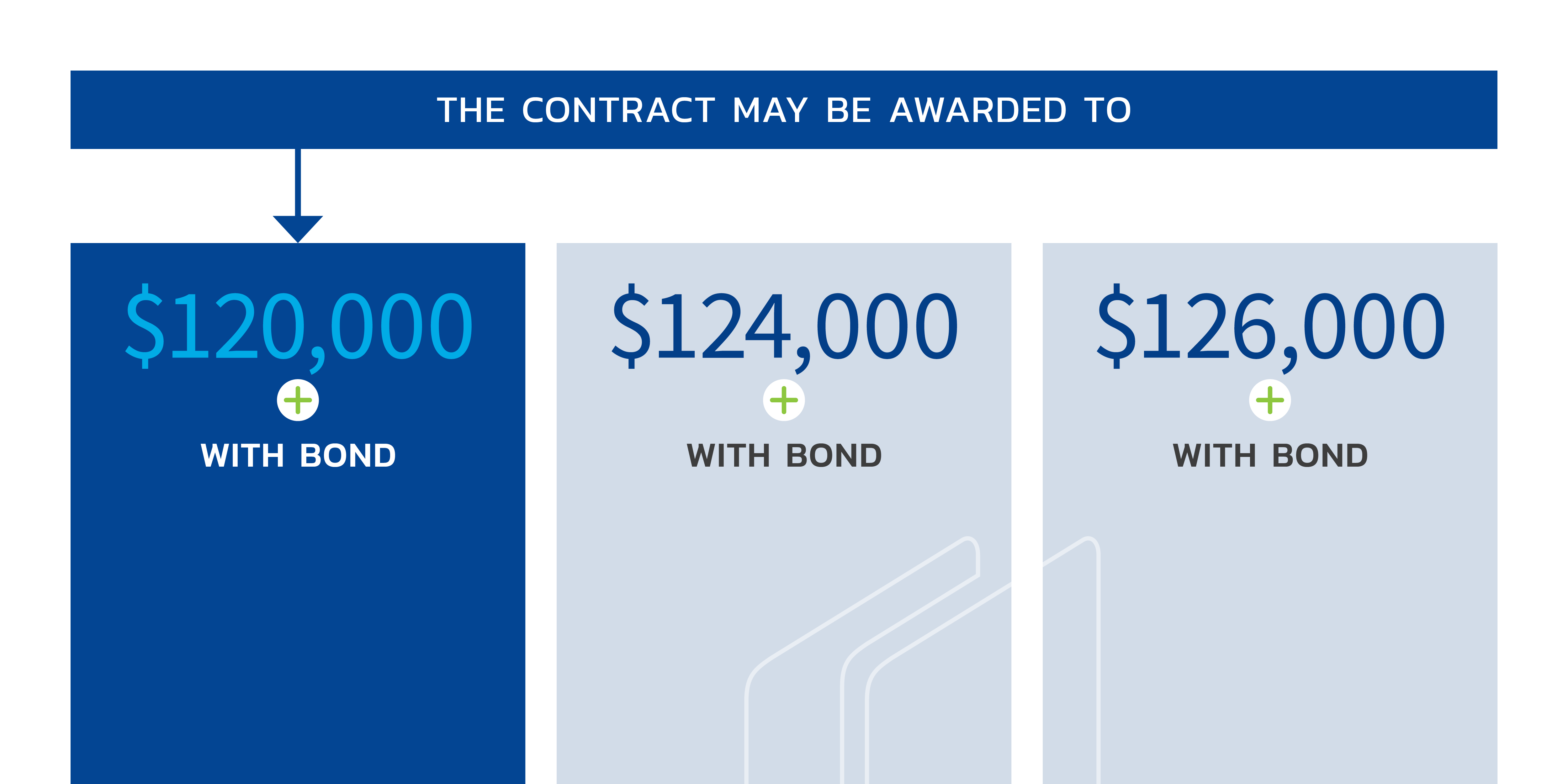
- When the bid amounts are below $100,000 before taxes, a guarantee is not mandatory. In this case, if none of the bids include a guarantee, the contract may be awarded to the compliant bidder of choice.
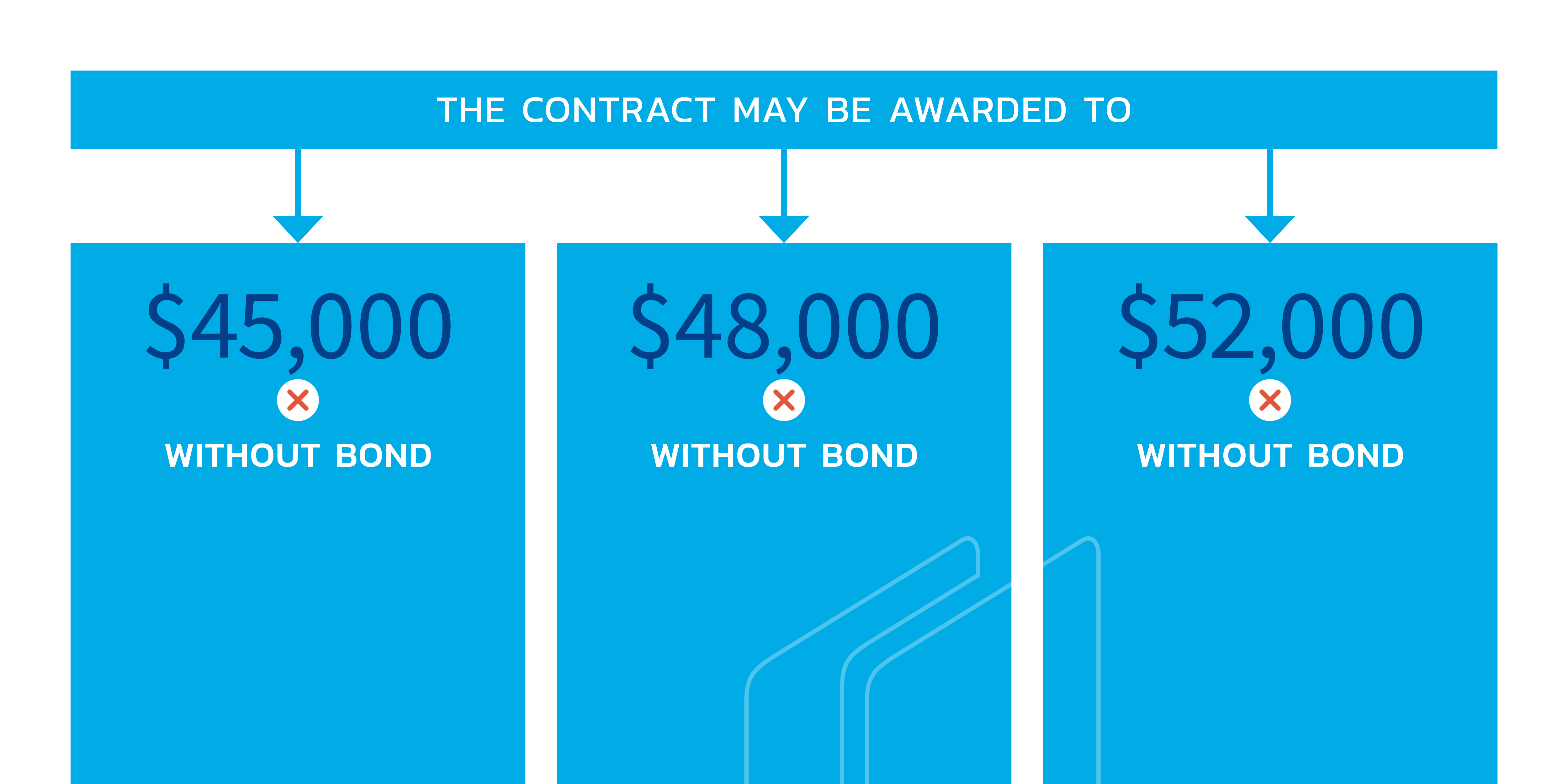
- When some bids are accompanied by a guarantee and others are not, the contract can be awarded to any bidder whose bid amount is lower than the lowest guaranteed bid. Consequently, a contract cannot be awarded to a bidder whose bid amount is higher than the lowest compliant and bonded bid.

Please note:
- A contract must be awarded based on the price and conditions of the submitted bid.
- The BSDQ does not determine the compliance of bids.
There are certain exceptions to the requirement of awarding the contract to the lowest compliant and bonded bidder. For more details about these exceptions, please contact the application of the Tendering Code service at 514-355-7600 #2.
Additionnal information
Related Tendering Code articles
It should be noted that, for interpretation purposes, the French text shall prevail over the English, the latter being a translation of the French original.
Chapter I - Article I-5
I-5 Prohibition on contracting without a recall for tenders in the event of changes to the tendering documents, except for the lowest compliant tenderer
No contractor, except the tenderer who filed the lowest compliant tender during the initial call for tenders, may contract for work in a regulated specialty other than that covered by their tender during the initial call for tenders, unless a recall for tenders has been authorized in accordance with the provisions of this chapter.
Chapter J - Articles J-1 à J-6 et J-9
J-1 Contract following a tender
Subject to Section I-5, the tenderer and the successful recipient contractor may only enter a contract for a regulated specialty to the prices and conditions of a tender filed in accordance with this Code.
The tenderer and the successful recipient contractor may not agree to a reduction in the price of a tender filed in accordance with this Code, nor to a commission, discount, share, or other benefit that would have the effect of changing the actual price.
J-1.1 Payment discount
A discount granted in exchange for faster payment (payment discount) and freely agreed upon at the time of conclusion of the contract between the lowest compliant tenderer and the successful recipient contractor shall not be deemed to contravene Section J-1 of this Code.
The same applies to a payment discount freely granted at the time of conclusion of the contract between the tenderer designated by the project owner in accordance with Subsection (a) of Section J-3 of this Code and the successful recipient contractor.
However, unless required by the tendering documents, such a payment discount may never be considered in determining the ranking of tenderers.
The successful recipient contractor and the tenderer may not refuse to enter a contract with each other on the grounds that one of them refuses to agree to such a payment discount.
J-2 Awarding of the contract to lowest compliant tenderer in cases where a tender security has been provided by the tenderer
The successful recipient contractor is required to award the contract for a regulated specialty to the tenderer who addressed to them the lowest compliant tender and of which they have taken possession, subject to the provisions of Sections J-3, J-4 and J-6 of this Code, in all cases where the tenderer has provided, together with their tender, a tender security in accordance with the
provisions of Chapter D of this Code, whether or not such a security is required by the tendering documents or by this Code.
Thus, in cases not provided for in Schedule III of this Code, the obligation to award the contract to the lowest compliant tenderer is maintained only if the latter has attached a tender security to their tender. If the lowest compliant tenderer has not attached such a security to their tender, the successful recipient contractor is no longer bound by this rule. However, the successful recipient contractor may only award the contract to a tenderer who has addressed a compliant tender through the BSDQ, of which they have taken possession, and at the price and conditions of that tender.
In addition, the successful recipient contractor may not award the contract to a tenderer whose tender price is higher than the price of the lowest compliant tenderer who has provided a tender security.
J-3 Cases where a request for permission to award a contract to a tenderer who did not file the lowest compliant tender is granted by the BSDQ
The request to award a contract to a tenderer who has filed a compliant tender, but who has not filed the lowest tender will be granted in either of the following circumstances:
- when the project owner requires in writing that the subcontract for a regulated specialty be awarded to a tenderer who has filed a tender through the BSDQ in that regulated specialty but who is not the lowest tenderer, and if the contract with that tenderer is awarded at the price and conditions of the tender that they themselves filed in accordance with the Code;
- when a comparison of the various tenders filed does not make it possible to determine which tender is the lowest because these tenders relate to different works, provided that the contract with the successful tenderer is then awarded at the price and conditions of their tender;
- when the lowest compliant tenderer refuses to enter a contract or when, despite filing a letter of intent, the lowest compliant tenderer is unable to obtain a performance bond and a bond for the payment of labour and materials;
- when, following a written request by the recipient contractor, the lowest compliant tenderer has refused to extend the validity period of their tender under the same conditions as those required of the recipient contractor by the project owner.
The request made to the BSDQ must be in writing and contain the reasons justifying it. All contractors concerned must have received a copy of the request and may make written representations to the BSDQ and provide any evidence they deem useful.
The BSDQ may, in all cases, require the filing of written and sworn statements and must rule on the request within ten (10) days of their receipt.
J-4 Awarding of contract to a tenderer who has not filed the lowest compliant tender without BSDQ permission
In an emergency, the successful recipient contractor may award a contract to a tenderer who has not filed the lowest compliant tender without BSDQ permission provided the conditions mentioned in section J-3 of this Code are met.
The BSDQ may investigate and may thereafter proceed in accordance with the provisions of Chapter L of this Code, without prejudice to the rights and recourses of any tenderer who thinks he has been wronged.
Subject to the requirement of the project owner set out in Subsection a), when the BSDQ agrees that the contract should not be awarded to the tenderer who addressed the lowest compliant tender to the successful recipient contractor, the latter may only award the contract to the compliant tenderer who addressed to them the lowest tender immediately after the tenderer covered by a request made in accordance with this Section.
J-5 Contract with a recipient contractor
A tenderer may not enter a contract with a recipient contractor to whom they have not addressed a tender through the BSDQ, or who has not taken possession of it.
J-6 Awarding of the contract to a non-compliant tenderer
The successful recipient contractor shall not be liable to fines or disciplinary measures or be required to pay penalties or damages if they have awarded the contract to a tenderer whose tender was noncompliant, if this non-compliance was not significant enough to change the fact that the latter’s tender price was the lowest and if there was no room for bargaining.
A tenderer who has filed a non-compliant tender may, in the circumstances referred to in the preceding paragraph, be subject to fines or disciplinary measures or a penalty but may not be ordered to pay damages.
A tenderer who has filed a non-compliant tender within the meaning of the first paragraph of this Section may not, on that ground, refuse to contract with the successful recipient contractor.
J-9 Waiver of injunctive relief
Tenderers and recipient contractors waive their right to seek injunctive relief in the event of noncompliance with the rule set forth in Section J-2 of this Code.
Chapter K - Articles K-2 et K-3
K-2 Related group
A contractor who forms a related group with a contractor who has filed a tender through the BSDQ for a given project is deemed to have signed the commitment in C-1 with respect to that project and, where applicable, may only enter a contract if the provisions of Section K-3 of this Code are complied with.
A contractor who forms a related group with a contractor who has received tenders through the BSDQ for a given project is deemed to have signed the commitment in C-2 with respect to that project and, where applicable, may only enter a contract if the provisions of Section K-3 of this Code are complied with.
A tenderer or recipient contractor may not call upon a person with whom they form a related group if they call upon that person to contravene the rules of the Code.
In the event of a violation of the provisions of the Code, the related businesses are jointly and severally liable for any penalties, damages, fines, or disciplinary measures that may result.
K-3 Contract assignment
The tenderer who has signed the commitment provided for in Section C-1 or the recipient contractor who has signed the commitment provided for in Section C-2 must ensure that, when assigning their contract to another contractor, the latter undertakes to comply with the provisions of this Code. The contractor who assigns their contract shall nevertheless remain liable, together with the assignee, for compliance with the rules of this Code.